
Stay steady. Fall safer. Live independently.
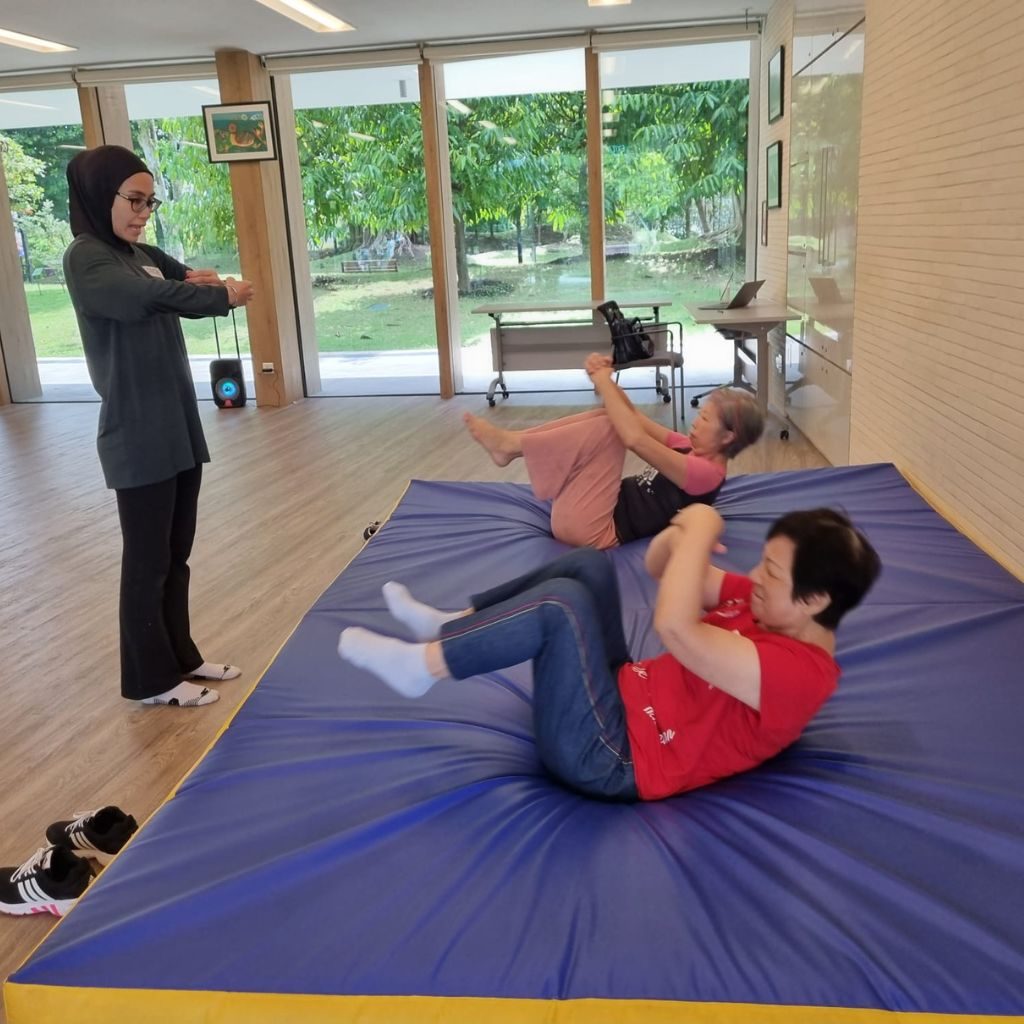
Rolling Good Times is an evidence-based falls prevention programme for seniors aged 50 and above. Over 13 sessions, participants build strength, balance and flexibility, learn to spot everyday fall hazards, and practise safe falling and rolling techniques that reduce injury if a fall does happen.
Recognise common fall hazards at home and in the community, and learn practical ways to avoid them.
Improve strength, balance and flexibility through exercises that progress each week, in line with the Singapore Physical Activity Guidelines.
Learn controlled rolling and safe falling techniques that reduce injury in the event of a fall.
Help seniors feel confident about staying physically active, independent and socially engaged.
Take this 10-second self-check, based on the Osteoporosis Self-Assessment Tool for Asians (OSTA). It gives a general indication of your fracture risk — one reason building strength and balance matters as we age.
Please enter a realistic age (18–120) and weight (25–200 kg).
This is an indication only, not a medical diagnosis. Final suitability for Rolling Good Times is confirmed by our coaches on Registration Day. For advice about your bone health, please speak to your doctor.
Rolling Good Times prevents falls — but a fall matters most when bones are fragile. The Osteoporosis Self-Assessment Tool for Asians (OSTA) is a simple, validated screen, developed for Asian populations and used across Singapore, that estimates bone-fragility risk from just your age and weight. No scan, no needles.
We use it because it shows who is most likely to benefit from building strength and learning to fall safely. It is one layer of how we protect participants:
Find your age row and weight column — the colour shows your risk band. Lower weight and older age sit toward higher risk. Run the self-check above and we will mark your square.
| Age · Weight (kg) | 40–44 | 45–49 | 50–54 | 55–59 | 60–64 | 65–69 | 70–74 | 75–79 |
|---|---|---|---|---|---|---|---|---|
| 45–49 | ||||||||
| 50–54 | ||||||||
| 55–59 | ||||||||
| 60–64 | ||||||||
| 65–69 | ||||||||
| 70–74 | ||||||||
| 75–79 | ||||||||
| 80–84 | ||||||||
| 85–89 |
Every participant is assessed on Registration Day, before the programme starts, and again in the final session, so progress is measured rather than guessed.
| Assessment | What it measures |
|---|---|
| Clinical Frailty Scale | Overall frailty and fitness level. Participants must clear this screen to enrol. |
| Gait Speed Test | A timed walk over a set distance that indicates mobility and fall risk. |
| Floor Transfer Test | How well a participant gets down to the floor and stands back up safely. |
| Four Square Step Test | A timed stepping sequence that measures dynamic balance and changing direction. |
All assessments follow HPB-prescribed protocols and eligibility criteria.
Health declaration, the four functional assessments, individual feedback on results, and a programme briefing. Only participants who meet the eligibility criteria are enrolled.
Stations recreate everyday fall hazards such as uneven ground, steps and reaching for objects. Participants learn safe ways to handle each one.
Each session covers a wellness check and warm-up, strength and balance exercises, rolling and safe-falling practice, a review of home exercises, and a cool-down. Exercises get harder each week, and rolling practice progresses from the mat to slightly higher starting positions.
Participants repeat the four baseline tests, receive individual before-and-after results, and take home an exercise plan.
Measured by the Gait Speed Test.
Measured by the Four Square Step and Floor Transfer Tests.
Reduce injury if a fall happens.
Home exercises keep participants active after the course.
Mats, fall mats, cones, steps and resistance bands — you provide the venue, we bring the rest.
Share your preferred venue, dates and expected number of participants, and we’ll prepare a proposal.